Adeel Hussain
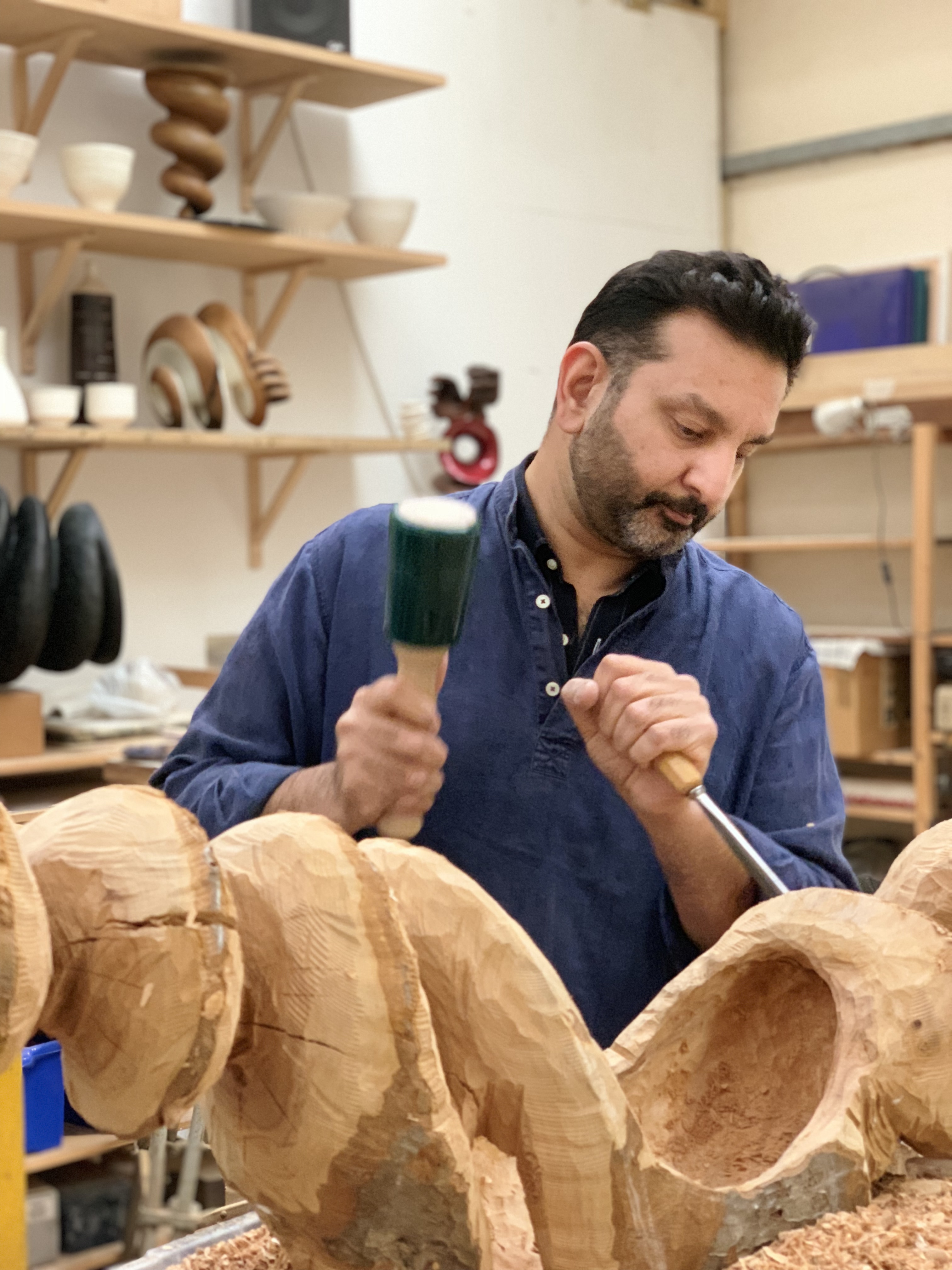
My first encounter with clay was at fifteen — a hand-coiled vessel, made during my art GCSE, in the shape of a sumo wrestler. Clay then sat waiting until 1996 when I began a Saturday class at Putney School of Art, studying under a teacher whose influence on my practice has endured ever since. Evening classes at City Lit followed, where I learned to sculpt in wood.
Growing up in London as the son of Pakistani parents, I was surrounded by people who made things and solved problems. My father — self-taught, practical, resourceful — made furniture, cooked, fixed engines. My uncle sculpted in wood and painted. My mother demonstrated the value of working hard and approaching any problem by first finding what good looks like, then breaking it into parts until it becomes solvable. These influences were enough of a model to allow the freedom for creative non-conformity.
I work in clay and wood, and both are expressions of the same impulse: hands on material, shaping it, listening to it.
Spirals, vortices and forms drawn from cosmology — black holes, gravitational pull, forms winding inward or spinning outward — recur throughout my work. Beneath these runs a quieter preoccupation: the push and pull between forces that constrain and the desire for freedom — of thought, of expression, of self. Growing up between two cultures, two sets of expectations, two ways of understanding the world, that tension has never fully resolved itself. My work doesn’t resolve it either. It holds it.
I am inspired by artists who understood / understand mass, space, and the expressive potential of simplified form. I am equally moved by makers who have learned to relinquish a degree of control — who understand that the material, given the right conditions, will sometimes arrive at something the maker alone could not have planned for.
By profession, I work in a world of systems, complexity and managed change. The studio is the necessary counterbalance to that. The making keeps me level. It is essential.
I wouldn’t tell you what to feel looking at my work. It would be enough to feel anything at all — and to want to reach out and touch it.
I live & work in London, UK.

